Thursday, January 3, 2013

SportsLab...Where Sports and Technology Intersect

Sports have embraced social media and technology to engage and inform fans. Everything from Facebook, Twitter, and Pinterest to streaming video and TV shows.

And, teams have been using the latest technology for dynamic pricing and secondary ticket markets for quite some time.
A football play.
However, when it comes to technology and the actual game, we haven’t seen much advancement up to this point. Yes, players and coaches have used film for ages to break down certain aspects of the game−both theirs and their opponents.

Who can forget Jon Gruden and Andrew Luck at QB Camp going over Spider 2 Y Banana?
Well, we are starting to see some movement in this area. Volleyball coaches are using ipads during matches. And, this past season, the Rose Bowl champion Stanford football team put their playbook on an ipad. And, this is a big step forward…as last season the Stanford players had to learn more than 200 new plays each week. Imagine having to print out 200 plus pages for 80 players, not including the coaches!

SportsLab is right at the heart of this new movement, changing the landscape of how playbooks are created and shared. The co-founders, Noman Ahmad and Monty Mitra, started by creating an easy-to-use mobile app for high school and college football coaches and athletes to collaborate and share plays.
In addition to making the creation of plays easier and more cost-efficient, this product really helps players on the field−as their studies have shown players retain 30% more strategy and are more prepared. It helps players become more engaged and understand the plays and their roles within those plays much better.

And, as Curtis McCauley, the football coach from McClymonds High School in Oakland, CA, said, “When it comes to x’s and o’s and the mental part of the game, that’s where it gets really complicated. That’s where games are won and lost. If we had a tool to communicate this better to the kids, we’d be that much better. I used to give the kids playbooks…they don’t read them…this is a wonderful tool for us…this is taking us a step in the right direction.”
Recently, I sat down with Noman to learn more about SportsLab.

PJ: Where did you get the inspiration for this product?
Noman: I grew up in Oklahoma with a passion for sports. My co-founder, Monty, is from Texas. And, sports are woven into the fabric of the culture in Texas. We’ve always been technologists and tried to dream up ways that technology intersected with sports. My nephew is playing high school football and I see the challenges he faces. What SportsLab is doing is trying to help players get better for their team.

PJ: How did you get started?
Noman: We launched the web app in August of 2012 in a beta test with 100 teams using and engaging with it. They wanted to see an ipad app, but we didn’t have the funds to do it. We have the prototype completed, but do not have full funding to test it, road map it…finish it and get it in the AppStore.
PJ: Tell me about this project with a high school in Oakland, CA, to test pilot your ipad app.
Noman: We’re making a difference in the local Oakland community. We have a test pilot with McClymonds High School. We believe it’s a compelling story. Technology usually goes to the highest earners. But, we are bringing this to under privileged, challenged areas. After hearing about this Oakland High School and Lincoln High School in Southern California both wanted to be involved. It’s interesting, they are going after it.

Editor’s note: Oakland High School jumped onto the project after this interview took place.

PJ: For this project with McClymonds High School, you are using a crowd-funding site to raise funds. How does this work?

Noman: indiegogo is great. It draws attention to the community to drive entrepreneurs to deliver the wanted platform. It helps develop a following and the community doesn’t allow you to have tunnel vision. It opens your spectrum and vision to make the best possible product available.
When talking to coaches and athletes, it’s not about the features, it’s about the experience. This is why we decided to get up on a crowd-funding site.

PJ: Tell me about the competition you face in this space and how your product is different.
Noman: We have a few competitors, but they are focused on BCS teams and the pros. We focus on high school and college, which is unique. The way we do it, helps save cost and time. We facilitate the creation and sharing of plays. It’s about collaboration and gaining feedback to develop great features focused on the players instead of having a massive playbook.

We can really win against our competition by focusing on developing the tool we want to deliver…easy to use, but allowing powerful things to happen. In my background, there are a whole bunch of things that need to happen on the front end to make it easy for consumers. Just like Apple and Google do it.
PJ: What’s next for the product?
Noman: With the pilot we’ll figure out what things the athletes and the coaches want to do with it. We’ll expand out and deal with platforms that are accessible today and roadmap…getting information to help athletes get better. Our big vision is for self-empowerment…really the ability for athletes to make better decisions on their own time.

We’re focused on more adoption and traction…and a bigger presence by next football season.

For more information on SportsLab http://www.sportslabhq.com/
For more information on the McClymonds project and to invest http://www.indiegogo.com/sportslab

Thursday, December 27, 2012

Earl Cureton...and the Two-Minute Drill

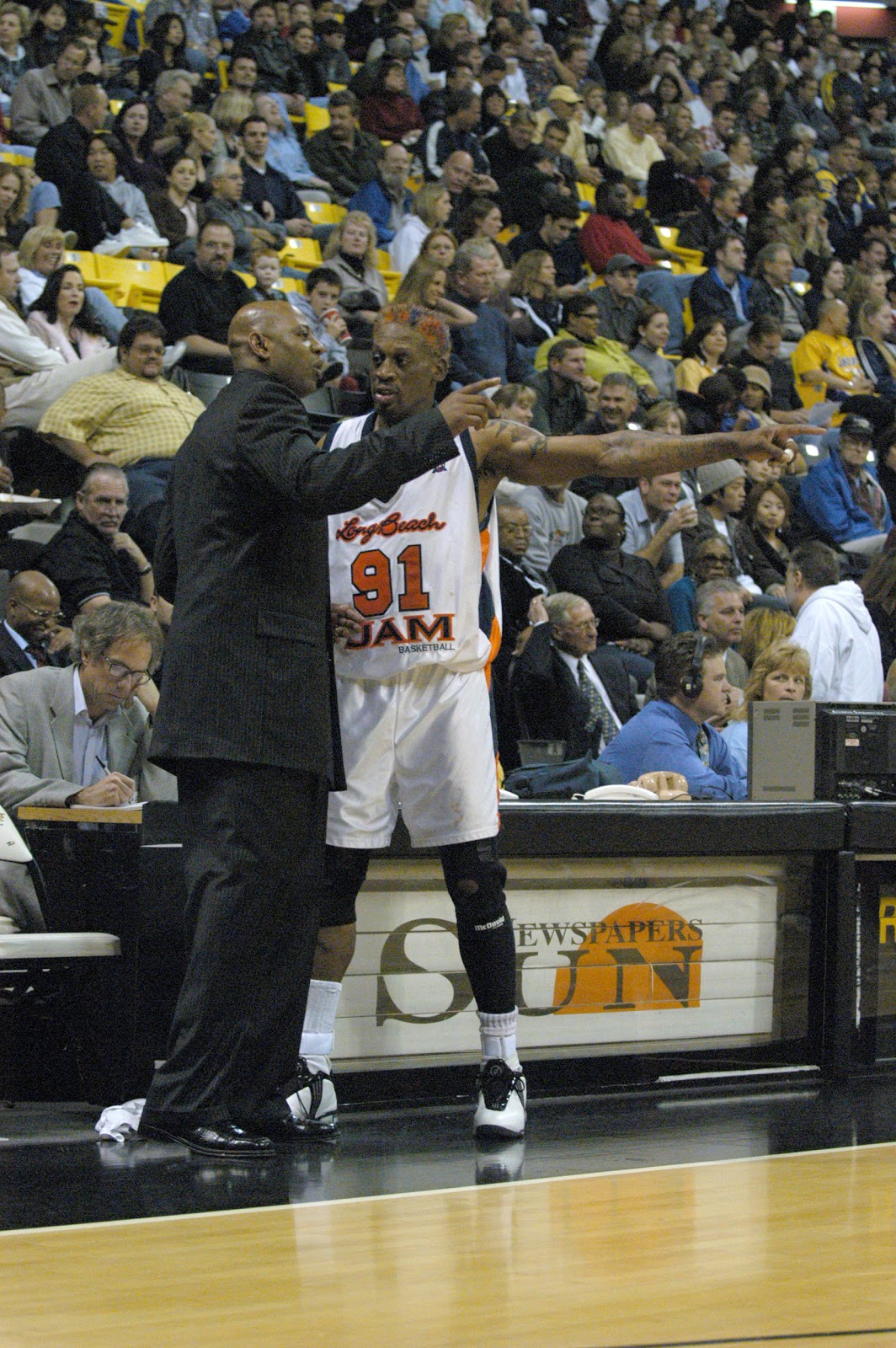
As we are in the midst of the NBA season, I thought it might be a good time to look back…with Earl “The Twirl” Cureton, a two-time NBA champion.

Earl coaching the Long Beach
Jam of the ABA.
Earl’s first title came with the Philadelphia 76ers in 1983 playing with Dr. J., Bobby Jones, Maurice Cheeks, Andrew Toney, and Moses Malone. And, he capped off his career winning in 1994 with the Houston Rockets and Hakeem Olajuwon, Vernon Maxwell, and Robert Horry.
The 76ers picked Earl in the third round of the 1980 draft. He came out of Detroit Mercy averaging 19.9 points per game.

Throughout his career he played with the Detroit Pistons, Chicago Bulls, LA Clippers, Charlotte Hornets, and Toronto Raptors, accounting for 674 NBA games, 54 playoff games, 3,172 rebounds, and 3,620 points. He also played in Europe−Italy and France−in the CBA and USBL.
Since retiring in 1997 he has stayed connected to the game by coaching and broadcasting. This past season he was an assistant coach for the WNBA’s Phoenix Mercury.

He’s coached two other WNBA teams−Charlotte and Detroit−and in the ABA and USBL.
On the broadcasting side, he’s worked for FoxSports covering college games, the Pistons, and has also done radio in Charlotte and Toronto.

Earl getting his diploma.
One of his most significant accomplishments came in May of 2011, when he graduated college. It was a Mother’s Day present to his mom. He promised her he would get his degree, but just didn’t…until 32 years later. Earl also wanted his degree for himself and to give a truthful message to kids about education and its importance. As Earl says: Basketball… that comes and goes but your education is always going to be with you for the rest of your life.
I talked to Earl about his career both on and off the court.

PJ: You started your career with the Philadelphia 76ers. How was the transition into the league?
Earl: I was in the right places. Philadelphia was one of the top teams in the league when I came out of college. This put me in a position to win at the beginning of my career. It was a blessing to have an opportunity to be with a team like that.

In college I idolized Dr. J. In my time, he was like Kobe or LeBron. I had posters hanging on the wall in my room freshman year…and three years later I was in the same locker room with him and with a cast of great players like Bobby Jones, Maurice Cheeks, Darryl Dawkins, Doug Collins, and Caldwell Jones.
I remember at rookie camp, Coach (Bobby) Cunningham said…I know you idolize these players, but now is the time to get that off your mind—you have to compete with these guys for jobs now. He put perspective on it.

PJ: Tell me about life after the 76ers.
Earl: During my career I went from Philadelphia to Detroit…two great places. And, I had a stop in Chicago. I played with Isiah Thomas and others (Michael Jordan, John Paxson, Joe Dumars, and Rick Mahorn) on teams that were building to a championship. I was fortunate at the end of my career to play with the Houston Rockets. They needed help and the basketball gods were looking out for me. I backed up (Hakeem) Olajuwon. I got quality minutes against Utah and Phoenix (in the playoffs) and played strong.

PJ: You played professional basketball over 17 years. What is your secret to having such a long career?
Earl: As a role player I took care of my body…kept in shape. I wasn’t playing 40 minutes a game. Sometimes it’s better to be a role player. You don’t have the pressure to get the points, etc. And, your career can be longer. In my situation I played limited roles and it enabled me to play longer.

The strength and conditioning goes back to college. Dick Vitale was my coach at Detroit Mercy. He did a great job preaching to us what we needed to do to have a long career in the NBA−staying in shape. I developed my work habits there.

Back then, strength and conditioning was not a main focus. It was not year round…players would take the summer off. Now, it’s year round to get the edge. I was ahead of my time. I’d come to training camp in shape. It was an advantage for me. It was the little things that keep me in the league so long.

PJ: Did you ever think about what would happen when your basketball career ended?
Earl: You always know in the back of your mind that it will end. It’s not the focus you have when you start playing…what’s next? My thing was survival. I had to fight to be with good teams.

Basketball was my whole life. If you’ve done something for 20 years it’s hard to look somewhere else.
I like coaching and broadcasting. They both keep me close to the players. Isiah (Thomas) was in Toronto when I retired and he gave me the opportunity to do radio and be an assistant conditioning coach.

I coached in the minor leagues (Matt Barnes and Lamar Johnson were two players that made it to the NBA). I liked helping kids on the edge of making the NBA.
I coached my daughter’s 7th grade basketball team…and it kept me smiling every day.

PJ: I know you have worked with Kurt David, a counselor and advisor, who helps former athletes in determining what to do when the cheering stops. What is it like working with him and what advice would you give other players who are facing the transition after playing?
Earl: Find something you enjoy doing and give yourself options. It’s difficult to replace what professional sports brings. There are not a lot of jobs with 20,000 people cheering for you.

I met Kurt and he has given me valuable information to continue with my career and get refocused on where I want to go. He’s helped motivate me. I like the things we talk about. Kurt talks to me about…staying focused and staying after it and finding the door that will open for you.

Thursday, December 20, 2012

Storm Kirschenbaum...a sports agent providing a personal touch

When you think of a sports agent, you typically think of Tom Cruise’s character in Jerry Maguire…before he wrote his manifesto and turned into a caring agent.

Most are cutthroat and only devote their time to their top, money clients.
In real life you may think of baseball agent Scott Boras. Rumor has it Boras was a major reason Stanford pitcher Mark Appel, who was predicted to go first in the baseball draft last year went eighth—teams did not want to negotiate with Boras. Appel ended up back at Stanford for another year.
Storm Kirschenbaum
However, not all agents fit this mold. Storm Kirschenbaum of Metis Sports Management is one of the good guys.
He prides himself on serving his clients with a personal touch and exemplifies honesty, integrity, and loyalty in his work.
He was recognized this year by Crain’s in its 40 under 40 list; and his agency was named by Masters in Sports Administration as one of the Top 100 Sports Agencies Scoring Big in 2012. He is the co-founder of the Michigan Boxing Hall of Fame and sits on the board of the Inner City Exposure Foundation.
On October 22 of this year he was inducted into the Michigan Jewish Sports Hall of Fame for his stellar collegiate baseball career. He played for the then No. 1 ranked University of Florida alongside teammates David Eckstein, Brad Wilkerson, Mark Ellis, and Josh Fogg (all major leaguers), hitting .312. He played his last two seasons at Long Island University – C.W. Post (Division I), and continued hitting at a good clip, finishing with a .306 batting average.
Storm joined Hank Greenberg, Aaron Krickstein, and his dad (who served as Michigan’s boxing commissioner from 1981-92), among others in the Hall of Fame.
Kurt David, a transition consultant for professional and Olympic athletes, an author, a TV host, and a speaker, who was featured in this blog at the end of March, commented on Storm’s recent honor:
“Storm’s induction into the Jewish Hall of Fame solidifies a long string of honors bestowed upon him over recent years. What’s amazing is the fact that he’s accomplished so much already in his life, and will no doubt continue to positively impact others. I consider myself fortunate to have Storm in my corner.”
His agency serves both current and former athletes offering a range of services. They currently represent 70 professional baseball players−15 who are vying for spots on major league rosters this spring.
I talked to Storm about life as a sports agent.
PJ: As an agent what is your role going up to the NFL draft?
Storm: When we have a player who is going to be drafted and he is done with his last college game we meet and he signs a contract. Then he takes a day or two off to gather his belongings and goes to training to prepare for the NFL combine and Pro Day. We invest in them at this point. We pay their housing; give them a car and an allowance, while in training.
From their last game to the draft, our job is to put them on the map…get them in the best shape possible and talk to teams, and set up visits with teams. We develop depth charts on each team to see where the player with their skills fits.
The draft is out of the agent’s hands. It is a misconception that agents manipulate. We generate an interest level. Teams draft players. All we can do is help them.
PJ: There is a lot of money involved. How and when does an agent make their portion?
Storm: The reality outside the signing bonus is that there is no guarantee. Form the third round down players will be competing for a spot on the roster. As agents we only get paid when the player gets paid. We invest between $5,000 and $50,000 up front depending on the round the player goes in. Yes, the model in football is a poor model. It’s high risk on our end. We front a lot of money. We take care of them…they are broke college kids hoping to make it.
PJ: How do you make money on players that are undrafted free agents?
Storm: Our fee for undrafted free agents is $10,000. We break even only if he makes a team and plays every game during the season. It could be a losing venture. For the undrafted, we generate a lot of interest from certain teams (Saints/Lions/Colts, etc., who are known for signing undrafted free agents). We try to make sure the player gets calls after the draft and can choose which team he goes to. We send film to teams and scouts who attend Pro Day. We do interviews with players and show how he comes across in a one-to-one setting, so they can see his character, etc. And, make lots of phone calls. During this time we have a high phone bill!
PJ: It must be hard for these players to watch the draft and not be selected. How do you help them through this?
Storm: It’s natural to watch the draft and think…I played against that guy and I am better than him and he got drafted. My job is to curb expectations. I tell them from the fifth round down you never know…a lot of things can happen. Be ready for whatever gets thrown your way. And, that them vs. a fifth round pick is the same. They aren’t getting paid a base salary because they are not playing yet.
PJ: What happens with these undrafted free agents?
Storm: Some guys are late bloomers and might make up for things with character, classroom knowledge and impress a coach. This is what you hope for. I pick character guys, students of the game, who work hard, always have a chip on their shoulder, and are always competing. A lot of variables come into play. Look at the Colts, Saints, and Jags…teams that take an undrafted free agent every year. A great example is Victor Cruz of the Giants. He was undrafted and now he’s a stud.
PJ: You also handle baseball players in your firm. What is your typical investment in a player?
Storm: We spend up to $1,500 in the beginning for bats, gloves, shoes. The bats that the team gives them are not great…guys what their own bats with their names on. We get equipment deals with Rawlings, etc. The team gives undershirts, maybe batting gloves, and shoes, if you are lucky.
We provide guidance to the players. There are a lot of off-field things we take care of. Remember, these are high school kids lacking in real-life skills. We coach them and are there for them. We help them get contracts for winter ball; obtain jobs for them in the off-season, and do public relations. This is similar to the investment side in football.
PJ: What other challenges do you face?
Storm: Maintaining clients and providing enough services so they are satisfied. So, if they do make it, they won’t leave. We are battling sharks and there are a lot of sharks out there. We try to make it a team approach so they trust what you’ve done in the past to get them a good contract.
I had represented a player for six years. We had a strong relationship, we were friends. At arbitration he switched to another agent. This was a hard, gut-wrenching call. But, I’ve learned from it and hope to prevent it from happening again.
PJ: How do you try to differentiate your firm from others and stop the migration of your clients?
Storm: It’s a shame when kids sign with bigger agencies. It sounds good, but you will be low man on the totem pole and when you need them they won’t be there. With us, a boutique firm, you get personalized attention. We strive for our services to be better than the big firms. We are in communication with our clients all the time. The locker rooms are small and when guys see our clients on the phone with us a lot, you can only hope they are interested in knowing more about us. It’s the little things that set us apart from the competition.
We signed around 45 new players this year and I like to think we are the fastest growing agency in the country. We are moving pretty quick.

Thursday, December 6, 2012

Chiney Ogwumike, Malcom Jenkins, Auggie Singh...and the notebook

During my first time around as a sportswriter I loved days when I had a notes section. So many times I covered an event or wrote a feature and there were great quotes or things observed that would never have gotten into the paper without this dedicated space.

Now that I am back in the game I have not had this luxury. Over the past few weeks some nuggets have stayed in the notebook and I haven’t been able to share.
So, I thought I’d use this space to share some outtakes from my interviews—high school, college, and pros.
I hope you enjoy these!
December 6, Auggie Singh, San Jose Mercury News high school field hockey player of the year

Auggie and her red bandana.
Photo courtesy of Sergio and Patricia Singh.
Senior Auggie Singh led Archbishop Mitty to a California Central Coast Section championship over Los Gatos by scoring the lone goal. Over the course of the season, she scored 30 times and chipped in 8 assists.
Auggie shared what’s with that red bandana:
“Yes, I have been wearing the SAME red bandana since I was nine! My parents were inspired by a national Argentinean field hockey player, Vanino Oneto, who also wore a red bandana. They got me one and ever since then, it’s been like my trademark and my lucky charm. I had started doing pretty well with it as a kid and have carried it with me, and plan to wear it throughout my field hockey career. I wear it to all of my tournaments and games, and it is just always something I rely on and something to set me apart from others.”
November 25, the Long Beach State-Stanford women’s basketball game
This was Stanford’s first game after they earned the No. 1 ranking. They defeated Long Beach State 77-41. 
At the time Chiney Ogwumike had earned player of the week honors from both the Pac-12 and espnW.
“Rebounding against Chiney is extremely tough,” said Long Beach State coach Jody Wynn. “She is not just a great athlete, but she has a killer instinct, which separates the good from the great. And…she is a great player.”
Stanford coach Tara VanDerveer on senior Josyln Tinkle, who led all Cardinal scorers in this game with 18 points: “Jos likes to score. She never met a basket she didn’t like.”
November 18, the New Orleans Saints-Oakland Raiders game
Saints safety Malcolm Jenkins picked off a pass from Raiders quarterback Carson Palmer and ran it back 55 yards for a touchdown. It was his first interception in nearly two years.
“When we have fun, we make plays,” said Jenkins, of why the then-ranked No. 32 defense in the league was starting to play better. “What comes first…the chicken or the egg? Do we have fun, then make plays or make plays and then have fun? We come in with the mindset to have fun and play well. We take advantage of every snap, every play.”

Wednesday, August 8, 2012

Brandon and Rich Marshall from the Olympics...The Food

I knew at some point Brandon and Rich would get around to talking about the food!


Breakfast of Champions
Brandon eating breakfast
No account of a trip would be complete without a discussion about the food. In a sport where your ability to compete is dependent on maintaining your weight, wrestlers are really missing out at the Olympics. There is some amazing food in London.

For the general public there is a great variety of food to choose from. My favorite is always food from the street vendors. As you walk along the streets you will be overwhelmed by the delicious aroma. I would recommend the Cornish pasties if you are running late to your event. It’s easy to eat on the go and quite filling. If you are more adventurous you would love the paella. Simmering in a giant cast iron pan, this mixture of flavors will warm you up in the damp English weather. 
The café in the Athlete’s Village is the largest in the history of the games. According to the London press, the athletes in the village will consume 25,000 loaves of bread and 75,000 liters of milk during the Olympics. They will eat more than 19 tons of eggs and approximately 330 tons of fruits and vegetables. The dining area is a place of camaraderie and ‘star’ gazing. Jordan Burroughs (FS 74kg) tried for more than a week to get a picture with the US gymnastics team. As soon as he did, interrupting Gabby Douglas’ lunch, he tweeted it to his followers!
No mention of food would be complete though without the golden arches. Yes, McDonald’s has a big presence at these games. Not far from the Olympic Stadium, McDonald’s built a two-story temporary restaurant. It is reported they serve 1,000 customers in an hour! It seems strange that fast food would be so central to a sporting event. I guess if it’s okay for Usain Bolt it can’t be all bad…..as long as you work it off like he does! Personally, McDonald’s has made it possible for me to communicate with friends, family and all of you at home. Nothing like free Wi-Fi with a side of fries! 

Tuesday, August 7, 2012

Brandon and Rich Marshall from the Olympics...Olympic Dreams

Brandon and Rich share their amazing experience.

Collision of Dream and Reality
Brandon and Rich and Brandon's
Olympic flag
Hanging in my room is an Olympic flag. My Uncle Scott gave me the flag as a reminder of why I work, train, and strive to be the best−on and off the mat. Through the years I have had the privilege of collecting signatures of Olympic wrestlers on this flag. Each night I close my eyes and dream about adding my signature someday. It would be an accomplishment beyond measure to sign that flag next to:

·         Rulon Gardner, who won Olympic gold in 2000 and bronze in 2004

·         Cael Sanderson, who won Olympic gold in 2004 and went undefeated four years
at Iowa State

·         Stephen Abas, who won Olympic silver in 2004 and was a three time NCAA
Division I champion

·         Jamill Kelly, who won Olympic silver in 2004

·         Dremiel Byers, who is a two-time U.S. Olympian

…and now Spenser Mango, another two-time U.S. Olympian.

So many names…there is not enough time to list them all. These are men that I admire for their character, spirit, and sportsmanship. Until now there has always been one dream that has seemed out of reach. 
Sitting in the Excel Center watching Greco-Roman wrestling I had one opportunity after another to meet and speak with Olympic greats. I was able to talk strategy with Kenny Monday, who won Olympic gold in 1988 and silver in 1992, and Dennis Hall, a 10-time U.S. national champion, world champion, and Olympic silver medalist in 1996.

I talked about college and my goals with Dan Gable, who won Olympic gold in 1972 and only lost one match in college! We reminisced about when he was my camp instructor at Camp of Champs along with these Olympians:

·         Ben Peterson, who won gold in 1972 and silver medal in 1976

·         John Peterson, who won silver in 1972 and gold in 1976

·         Barry Davis, who won silver in 1984

Kiki Kelley and Brandon
I met Christina “Kiki” Kelley, benefactor of the Kiki Cup, and we talked about her interest and involvement in wrestling. Each of these individuals was encouraging and offered their support and guidance as I continue to grow into this wonderful sport. They know that it is important to reach out to young athletes to keep that spirit alive in the United States. They represent the very best of the spirit of competition and mentorship. It was an overwhelming experience to be surrounded by so many greats in the sport.
The Russian Bear and Brandon
During a break in competition I went out to the open area for a breath of fresh air. There were big banners lining the walkway. One was of particular interest to me. It depicted Rulon Gardner and Aleksandr Karelin as they faced each other in the gold medal match in Sydney in 2000. As I posed for a picture next to the banner I recalled Karelin’s amazing history. He was undefeated in international competition for 13 years (1987-2000) and went six years without giving up one point. He won Olympic gold for Russia in 1988, 1992, and 1996. In September 2000 he faced Gardner and lost the match, marking his retirement from the sport. As long as I can remember I have dreamed of meeting the Russian Bear. I longed to see how I would measure up to the 6’3” master of the mat. As I started to walk away from the banner I heard a voice say, “I know him.” As I turned to go back to my seat, there he stood…Aleksandr Karelin. He pointed again at the banner and said, “I know him.” “Me too.” I replied. What more could I say? We spoke briefly and posed for the picture of my lifetime. Suddenly my dream was no longer out of reach.

As Victor Hugo wrote, “each man should frame his life so that at some future hour, fact and his dreaming meet.” The Olympics seems to be the ultimate clash of dreams and reality for so many. Some dream of gold, some dream of competition, some dream of opportunity…. all dream that their reality will be as good as they dream. In the future, when they ask who has signed my flag, someday I will respond again…… me too! Occasionally we find a moment in life that exceeds our expectations and dreams.

Monday, August 6, 2012

Brandon and Rich Marshall from the Olympics...Observations

Today, Brandon and Rich Marshall share some observations from London.


Heart of an Athlete
I was so excited the Olympics were in London this time. At least we wouldn’t have to worry about a language barrier. Well, that couldn’t have been further from reality! Every place we look there are people of different nations. Just sitting in one restaurant we have heard German, Russian, Chinese, Spanish, Italian and English. The amazing thing is….everyone is talking to each other.

Brandon in front of the flags of all the nations
competing at the Olympics
Competition grabs the interest of people worldwide. In every nation young people share a single dream – faster, higher, stronger. They struggle and train for years to achieve this goal. Then for two short weeks they join together to create an event like no other. Some will win medals, but all strive to achieve their goals. Not everyone can go home with the coveted gold, but what the athletes win is beyond measure.

In this one small restaurant I had the chance to share in that experience. Without understanding a word of what they were saying I felt each person’s pride in their nation’s best.

Nowhere is there more pride though than in the host city. London has welcomed the world with open arms. The organizers have thought through every detail. Waiting is minimal…crowds are given room to roam…and the people of London are eager to help.

There are no borders, no barriers, and no discontent.

For one moment we all have the heart of an athlete.